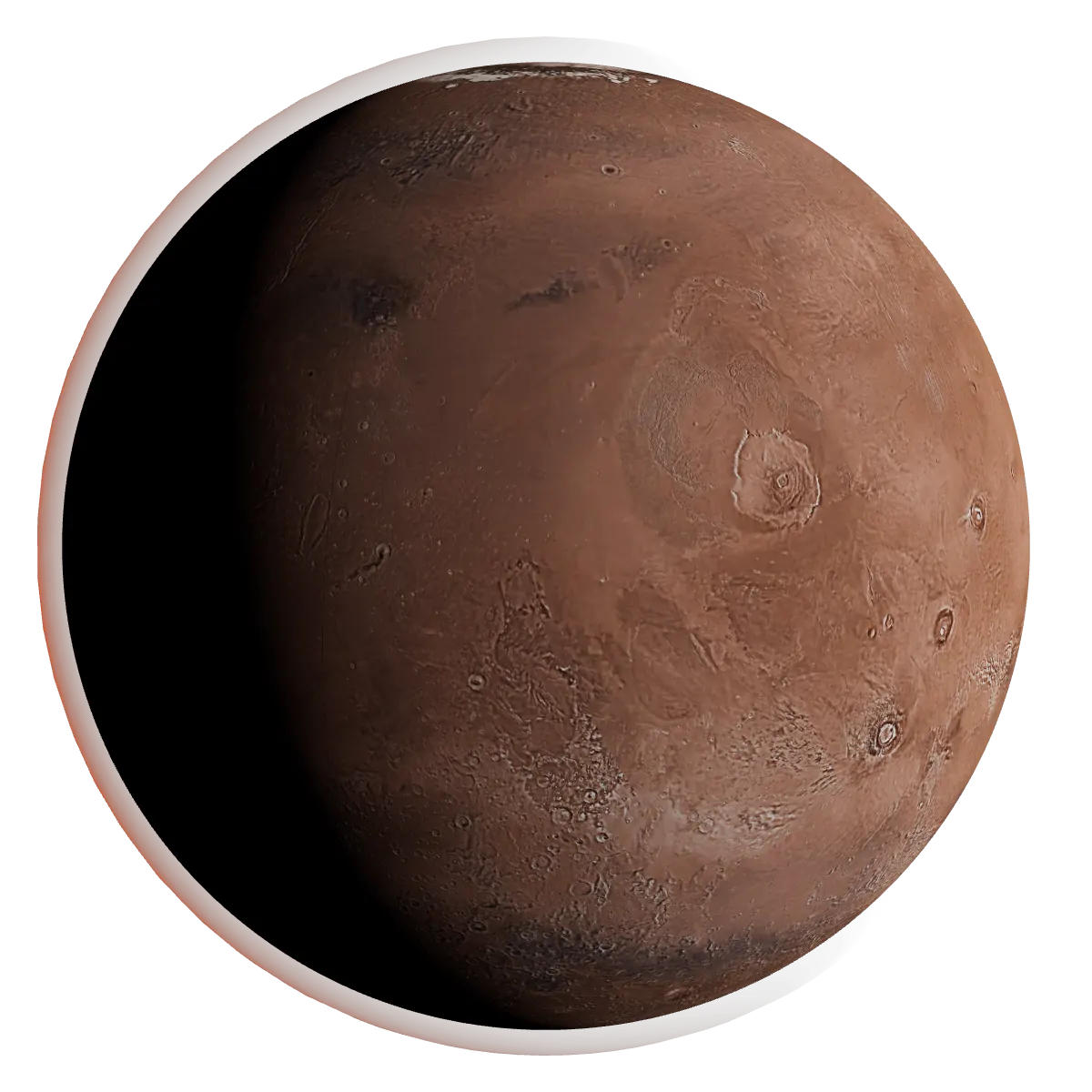
The destination
Mars is between 54.6 and 401.4 million km from Earth, depending on where both planets are in their orbits. It has a radius of 3,396 km, surface gravity of 3.73 m/s² (0.38 g) and a solar day, the sol, of 24 hours 39.6 minutes. The atmosphere is 95 % carbon dioxide at a mean surface pressure of about 6.4 mbar, roughly 0.6 % of Earth’s. Sunlight at Mars averages 586 W/m², 43 % of what reaches Earth.
The hard problems
Launch windows. Earth and Mars line up for a minimum-energy transfer about once every 26 months (the synodic period is 779.9 days). A Hohmann transfer then takes about 259 days. Faster trajectories exist, at a cost in propellant. In practice this means a Mars base is supplied in pulses: anything that breaks between windows has to be fixed with what is already there.
Communication. A radio signal takes 3.0 to 22.3 minutes each way, depending on distance. The crew, not mission control, runs the day.
Radiation. NASA’s Curiosity rover measured a dose equivalent of about 0.67 mSv per day at the surface of Gale crater, and about 1.8 mSv per day during the cruise from Earth. Over a 500-day surface stay plus two transits, that adds up to roughly 1 Sv, close to or above current career limits for astronauts. Shielding with regolith or ice matters.
Water. Mars has a lot of water ice, mostly in the polar caps and buried at mid-latitudes. Orbital imaging shows exposed ice sheets more than 100 m thick starting one to two metres below the surface in places. Getting to it is an excavation problem; the soil also contains perchlorates, measured at roughly 0.4–0.6 % by weight at the Phoenix landing site, which are toxic and have to be removed.
Dust. Regional dust storms happen every Mars year, and planet-encircling storms every few years. The 2018 global storm cut sunlight enough to end the solar-powered Opportunity rover’s mission. Solar power on Mars has to be sized for the bad season.
What this campaign models
Campaign 02 builds a surface base around those rhythms. You choose a site by latitude, ice access, terrain and sunlight; the campaign then plays out several launch windows. Cargo arrives only when the planets allow it, power drops in storm season, and the signal delay decides what can be controlled from Earth. Scores reward a base that keeps its crew alive and supplied between windows.
Terrain comes from public orbital datasets (MOLA elevation, Viking and later imagery). Resolution varies a lot by region, and the campaign labels it.
Status
In development. The product name and domain are not announced yet. Like every campaign, it keeps its number, 02, whatever it ends up being called.