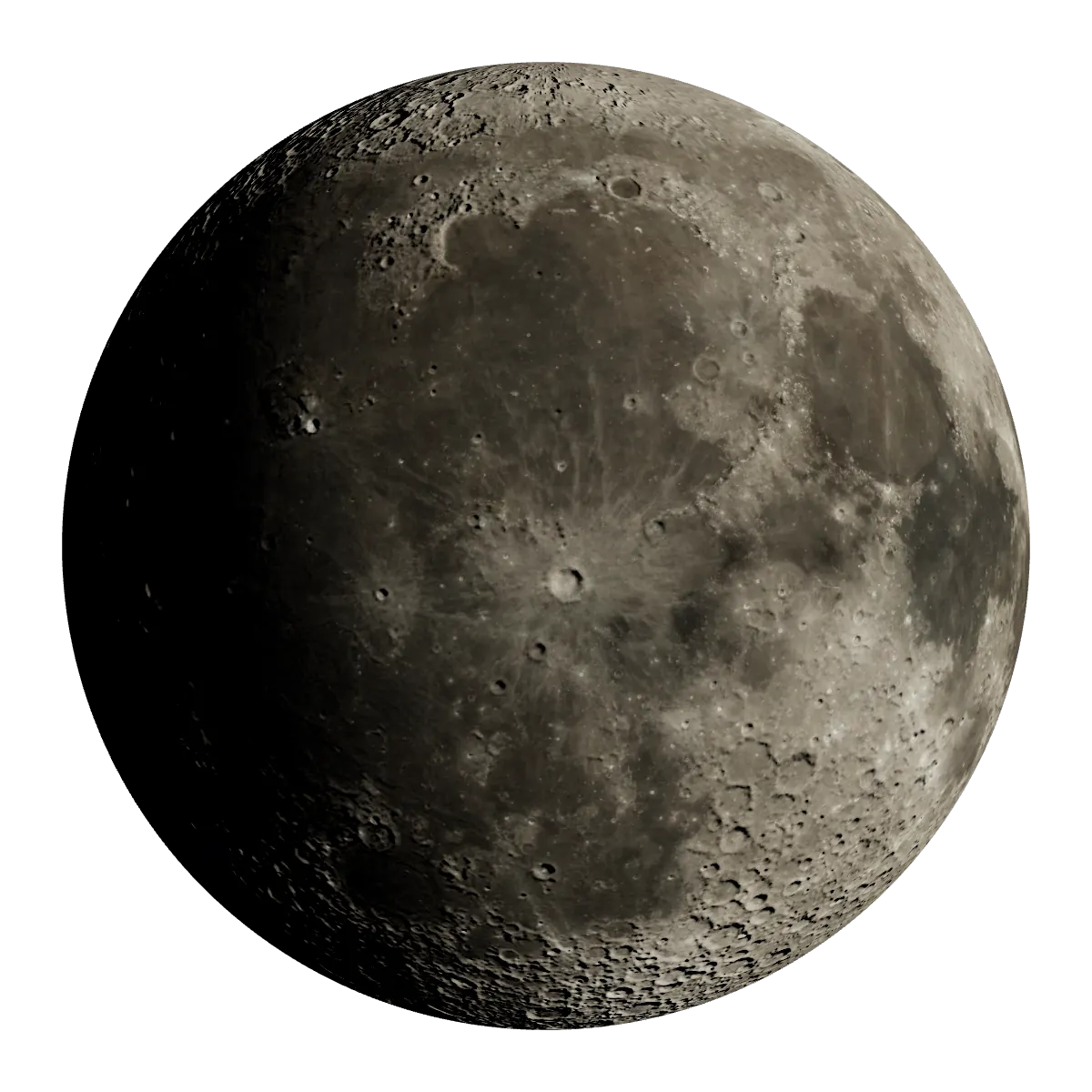
The destination
The Moon orbits Earth at a mean distance of 384,400 km. It has no atmosphere to speak of, surface gravity of 1.62 m/s² (about a sixth of Earth’s), and a solar day that lasts 29.5 Earth days. At the equator that means roughly two weeks of sunlight followed by two weeks of night, with surface temperatures swinging from about 95 K to 390 K.
The south pole is different. The Moon’s spin axis is tilted only about 1.5° to the ecliptic, so near the pole the Sun never rises more than about 1.5° above the horizon. It circles the sky, skimming the ridges. Shackleton crater, about 21 km across and 4 km deep, sits almost exactly on the pole. Parts of its rim and nearby ridges are lit for most of the year; its floor has not seen direct sunlight in a very long time.
The hard problems
Light. Solar power is the obvious choice, but at the pole the Sun is always low. A panel a few metres too far down a slope can sit in shadow for weeks. Siting is a terrain problem first, and an engineering problem second.
Water. Permanently shadowed crater floors are cold enough to trap volatiles. In 2009 NASA’s LCROSS impactor hit Cabeus crater and measured water at about 5.6 ± 2.9 % of the ejected regolith by mass. Water means drinking supply, oxygen and rocket propellant, but it sits in the darkest, coldest places, a few kilometres from the best-lit ones.
Radiation. With no magnetic field or atmosphere, the surface receives about 1.37 mSv per day of dose equivalent from galactic cosmic rays (Chang’e-4 measurement, quiet Sun), roughly 2.6 times the daily dose of a crew member on the International Space Station, according to the same study. Solar particle events add short, much stronger spikes. Regolith shielding is the practical answer.
Communication. A radio signal takes 1.21–1.35 s to cross the Earth–Moon distance, so about 1.3 s one way. That is short enough for voice, too long for joystick teleoperation of fast machinery. Earth also has to be above the local horizon, which at the pole depends on the month and on the surrounding terrain.
Getting there. Apollo crews reached lunar orbit in about three days. There is no long launch window to wait for, which makes the Moon the only destination where resupply is routine.
What this campaign models
Campaign 01 places you on the rim of Shackleton crater. The terrain is NASA LRO laser altimetry (LOLA) at 5 m per pixel near the pole, with coarser data outside the build area, labelled as such on screen. The sky is computed: where the Sun is, which ridges it lights, and when Earth is in view. You site solar arrays, habitats and an ice-mining route, and the campaign scores you on hours of power, line of sight home and how far the crew has to walk in the dark.
The 5 m grid is a mosaic: most of those pixels are interpolated between laser tracks. That matters for a rover path and not much for a power-tower siting decision. We say which on screen.
Status
Live. Campaign 01 is playable in the browser at moonel.com. It is the first product built on the Galaxy Campaign method, and the reference for the campaigns that follow.