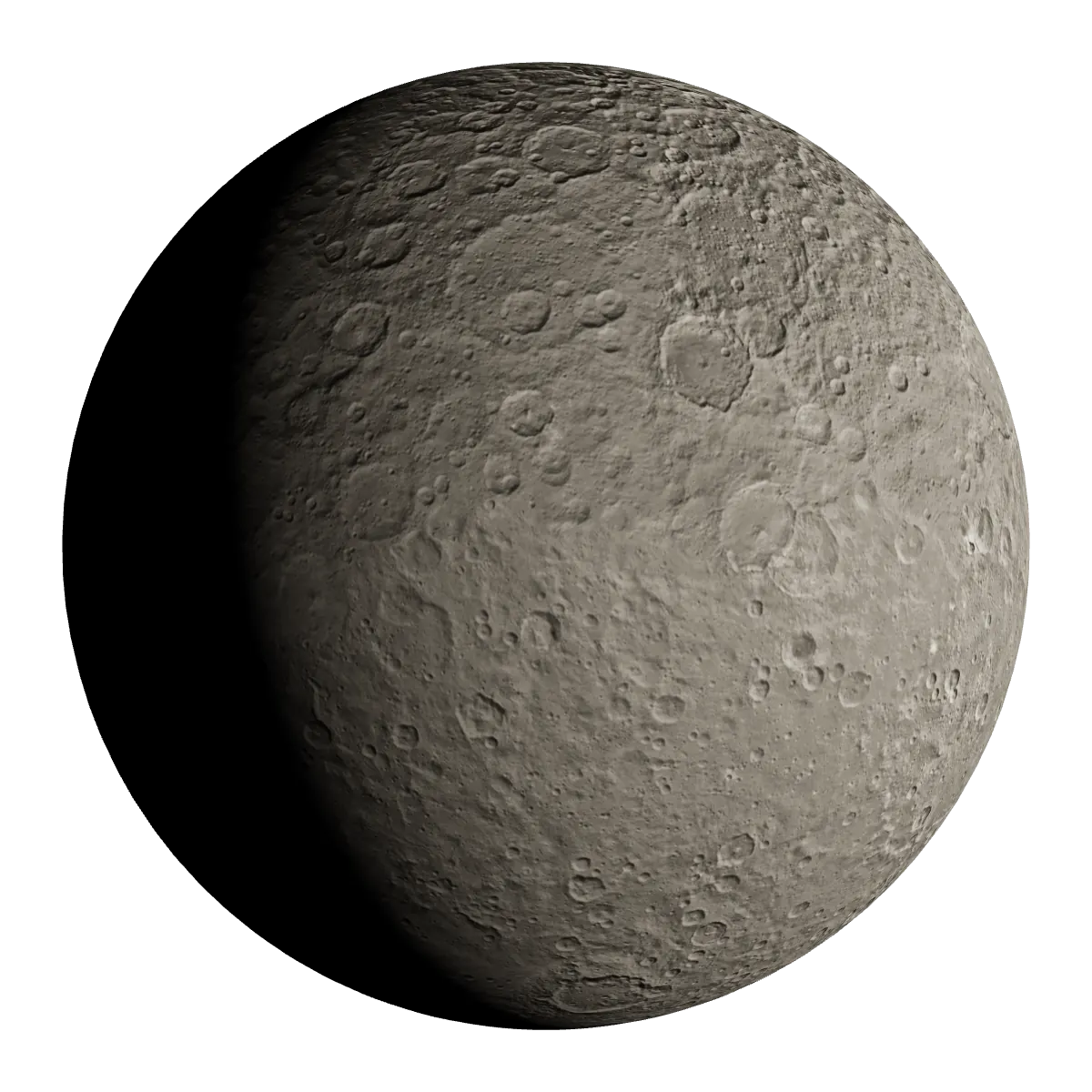
The destination
Ceres is the largest object in the asteroid belt, a dwarf planet 939 km across that orbits the Sun at a mean distance of 2.77 AU, about 414 million km. A year there lasts 4.6 Earth years and a day 9.07 hours. NASA’s Dawn spacecraft orbited it from March 2015 until its fuel ran out in late 2018, mapping the whole surface.
Dawn found a world that is partly ice. The bright spots in Occator crater turned out to be deposits of sodium carbonate, a salt left behind when briny water reached the surface and evaporated. Later gravity and imaging data point to a reservoir of brine roughly 40 km beneath Occator. Water ice is also present close to the surface at higher latitudes.
The hard problems
Gravity. Surface gravity is about 0.28 m/s², under 3 % of Earth’s. That is the main attraction: leaving Ceres takes a small fraction of the energy needed to leave the Moon, so water lifted from Ceres could be cheap propellant for the rest of the system. It is also the main difficulty: dust stays aloft, anchoring is hard and people would lose muscle and bone.
Light. Sunlight at Ceres averages about 178 W/m², around 13 % of Earth’s, and varies from about 152 to 209 W/m² over its slightly eccentric orbit. Solar power is possible with large arrays; nuclear power is likely for anything sizeable.
Cold and vacuum. Ceres has effectively no atmosphere, only a thin, transient trace of water vapour. Daytime surface temperatures reach about 235 K at most and are far colder at night and near the poles.
Communication. Depending on where Earth and Ceres are, a signal takes roughly 13 to 33 minutes each way. Everything routine has to run locally.
Getting there. A minimum-energy transfer takes about 15 months. Dawn used ion propulsion and a Mars gravity assist and took over seven years, with a stop at Vesta on the way.
What this campaign models
Campaign 03 asks a narrow question: could a small, mostly robotic station on Ceres produce water and propellant at a rate that makes it worth supplying from Earth? You choose where to dig, how to power the extraction and how to ship the product, and the campaign checks mass, power, heat and delay against the numbers above. The Dawn mosaic and topography set the terrain.
Status
Planned. Design work on Campaign 03 begins after Campaign 02. Figures on this page are reviewed against current sources when the campaign starts.