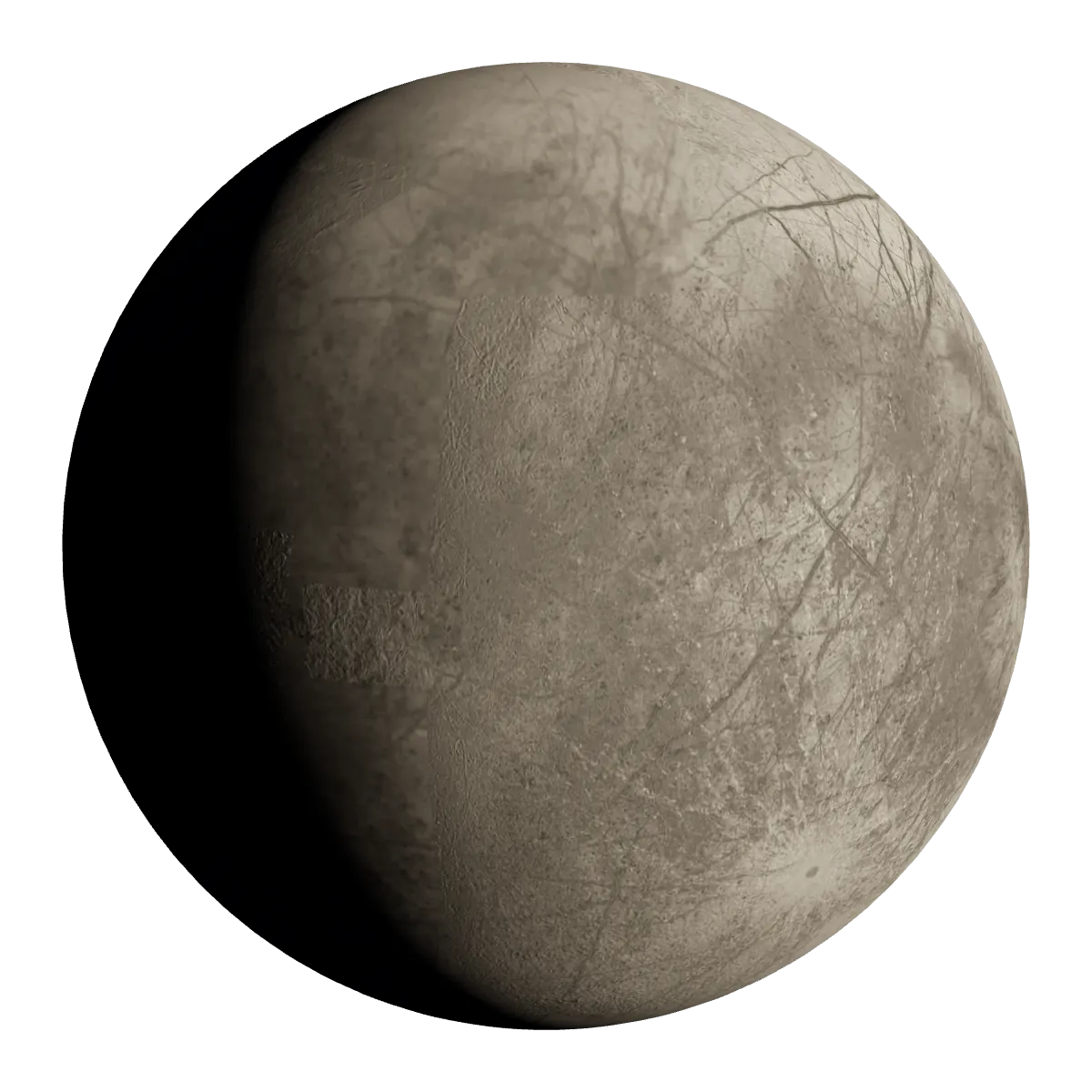
The destination
Europa is one of Jupiter’s four large moons, slightly smaller than our Moon at 1,561 km radius. It orbits Jupiter every 3.55 days and keeps one face towards the planet, so its day is the same length. Jupiter itself orbits the Sun at a mean 5.20 AU, and sunlight there is about 50 W/m², 3.7 % of what reaches Earth. The surface is water ice at no more than about 130 K at midday on the equator.
Under the ice is the reason to go. Magnetometer data from the Galileo mission point to a global salt-water ocean, likely deeper than all of Earth’s oceans combined. NASA estimates the ice shell above it at 15–25 km. A 2026 analysis of microwave data from the Juno spacecraft put it at 29 ± 10 km in the region Juno observed. The shell’s thickness is still one of the main open questions.
The hard problems
Radiation. Europa orbits inside Jupiter’s radiation belts. Energetic electrons and ions strike the surface constantly; modelling of Galileo data shows they chemically alter the ice to depths of about 10–20 cm near the equator and around 1 cm at higher latitudes. For people, the unshielded surface is lethal on a timescale of days. Any crewed station would sit under metres of ice or rock, and electronics need heavy shielding. We give no single Sv/day figure on this page because we could not trace the commonly quoted one to a primary source.
Ice. Reaching the ocean means melting or drilling through somewhere between 15 and 30+ km of ice. That is far beyond anything drilled on Earth through ice, and the campaign treats it as the central engineering question, not a solved step.
Light and power. At 50 W/m², solar arrays have to be very large. A station would almost certainly run on nuclear power.
Communication. Earth is 588 to 969 million km from Jupiter, so signals take roughly 33 to 54 minutes each way.
Getting there. A minimum-energy transfer to Jupiter takes about 2.7 years. NASA’s Europa Clipper launched on 14 October 2024 and arrives in April 2030, using gravity assists from Mars and Earth on the way. ESA’s JUICE, launched in 2023, will also fly past Europa twice.
What this campaign models
Campaign 04 is a research station, not a colony. You decide where to land, how deep to bury the habitat, how to power it and whether to try for the ocean. The campaign tracks radiation dose, heat flow, power and the time it takes to get an answer from Earth. Data from Europa Clipper will replace today’s estimates as it arrives.
Status
Planned. Campaign 04 will start after Europa Clipper’s first science results, so the station can be built on better maps than the Voyager and Galileo mosaics available today.